
Uneven skin tone, dark patches, and stubborn spots can make your skin look different from its natural appearance. These changes are common and may develop gradually because of sunlight, hormonal changes, acne, or skin irritation. Understanding what causes them is the first step toward choosing the right skincare routine.
Hyperpigmentation is a common skin concern that occurs when certain areas of the skin produce or collect more melanin than usual. Melanin is the natural pigment responsible for skin, hair, and eye colour. When too much pigment develops in one area, it can create brown, dark brown, or greyish patches.
Although these changes are usually harmless, their appearance can be frustrating. The good news is that several skincare ingredients, sun-protection habits, and dermatologist-guided treatments can help improve uneven skin tone over time.
In this guide, you will learn about common causes, different types, effective treatment options, and practical ways to care for pigmented skin.
Table of Contents
What Is Hyperpigmentation?
Hyperpigmentation refers to areas of skin that become darker than the surrounding skin because of increased melanin production or pigment accumulation.
It can appear on the face, forehead, cheeks, upper lip, neck, hands, arms, and other body areas. Some spots remain small and clearly defined, while others develop into larger patches.
The condition can affect people of every skin tone. However, people with medium to darker skin tones may be more likely to develop noticeable dark marks after acne, irritation, or skin injuries.
It is important to understand that not every dark spot has the same cause. Identifying the type of pigmentation can help you choose a more suitable treatment.
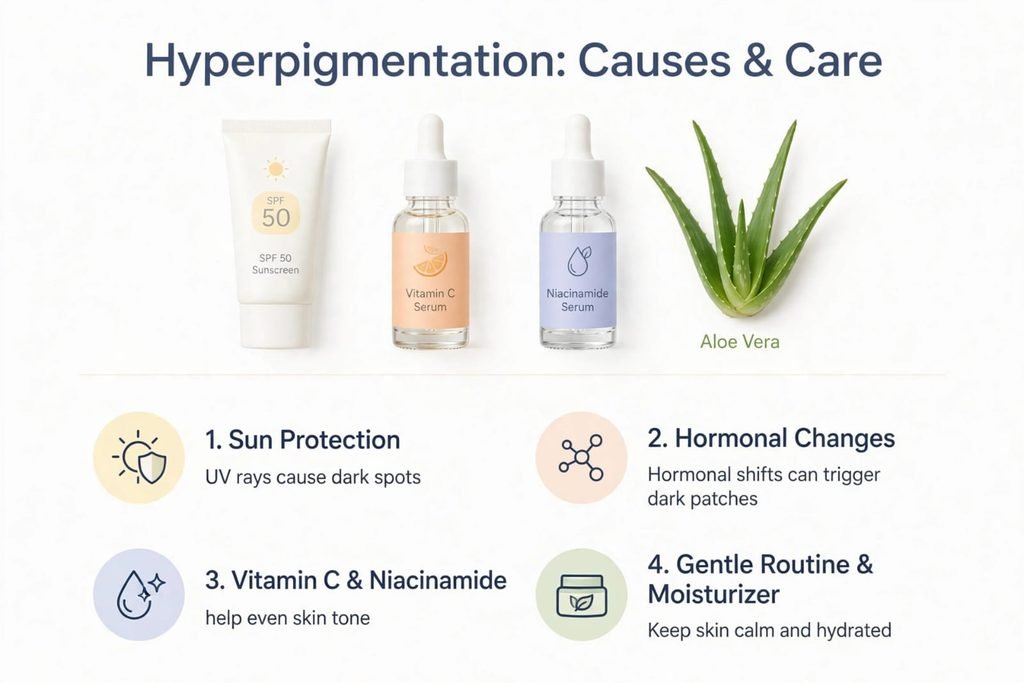
6 Common Causes of Hyperpigmentation
Several internal and external factors can influence how much pigment your skin produces. Here are some common reasons dark patches may develop.
1. Sun Exposure
Regular exposure to sunlight can stimulate melanin production as a natural response to ultraviolet radiation. Over time, this may lead to sunspots, uneven skin tone, and darker patches.
People who spend long hours outdoors without proper sun protection may notice these changes more easily.
2. Acne and Skin Inflammation
After a pimple heals, a dark mark may remain in its place. This is known as post-inflammatory hyperpigmentation.
It develops because inflammation stimulates pigment-producing cells during the skin’s healing process. Picking, squeezing, or scratching acne can increase irritation and make the resulting marks more noticeable.
3. Hormonal Changes
Hormonal fluctuations can influence pigmentation, particularly during pregnancy or when using certain hormonal medications.
One common example is melasma, which often appears as brown or grey-brown patches on the forehead, cheeks, nose, and upper lip.
Sun exposure can make these patches darker.
4. Skin Irritation and Harsh Products
Using strong exfoliants, unsuitable skincare products, or irritating beauty treatments can damage the skin barrier.
When irritation causes inflammation, dark marks may develop during healing. This is why aggressive scrubbing and combining too many active ingredients can sometimes make pigmentation worse instead of improving it.
5. Certain Medications
Some prescription and over-the-counter medicines can cause changes in skin pigmentation as a side effect.
The appearance and distribution of these changes depend on the medication and individual circumstances. Never stop a prescribed medicine without discussing it with your healthcare professional.
6. Skin Conditions and Medical Factors
Certain skin conditions, including eczema and psoriasis, can leave darker areas after inflammation settles.
Dark, thickened skin around the neck, underarms, or other folds may sometimes be associated with a condition called acanthosis nigricans. It can be linked to insulin resistance and other medical factors, so a medical assessment may be helpful.
4 Main Types of Hyperpigmentation
Understanding the different forms of pigmentation makes it easier to recognise why certain treatments work better for some people than others.
1. Melasma
Melasma usually appears as larger brown or grey-brown patches, particularly on the cheeks, forehead, nose, and upper lip.
Hormonal changes and sunlight are common triggers. It may become more noticeable during pregnancy or with certain hormonal medications.
2. Post-Inflammatory Hyperpigmentation (PIH)
This type develops after inflammation or injury, such as acne, insect bites, burns, cuts, or skin irritation.
The marks may look light brown, dark brown, or greyish, depending on the depth of the pigment and individual skin tone.
3. Sunspots
Sunspots are flat, darker marks that commonly develop on areas regularly exposed to sunlight, including the face, shoulders, hands, and arms.
They are associated with cumulative sun exposure and may become more noticeable with age.
4. Freckles
Freckles are small, flat, light-brown to dark-brown spots that often become more visible after sun exposure.
They are influenced by genetics and sunlight and are generally harmless.

10 Effective Ways to Improve Hyperpigmentation
Improving uneven skin tone requires patience and consistent care. The following approaches can help support healthier-looking skin.
1. Apply Sunscreen Every Morning
Daily sunscreen is one of the most important steps in managing dark spots. Sun exposure can increase pigmentation and make existing marks more noticeable.
Choose a broad-spectrum sunscreen with SPF 30 or higher. Apply it to exposed skin and reapply at least every two hours when spending time outdoors, or after swimming or sweating.
For melasma and darker skin tones, a tinted sunscreen containing iron oxides may provide additional protection against visible light.
2. Consider Vitamin C
Vitamin C is an antioxidant commonly used in skincare products to improve the appearance of uneven skin tone.
It can help protect the skin against environmental oxidative stress and support a brighter-looking complexion.
Choose a well-formulated product and introduce it gradually, especially if your skin is sensitive.
3. Try Niacinamide
Niacinamide, a form of vitamin B3, is a useful skincare ingredient for people concerned about uneven skin tone.
It can help reduce the transfer of pigment to surrounding skin cells. It also supports the skin barrier and may help improve overall skin appearance.
Use a suitable formulation regularly rather than applying several strong products at once.
4. Use Azelaic Acid
Azelaic acid is an ingredient used for acne and certain pigmentation concerns.
It can help improve the appearance of post-acne marks and uneven skin tone. It may be particularly useful for people who experience both acne and dark spots.
Start with a suitable concentration and follow the product instructions.
5. Include Gentle Exfoliation
Gentle exfoliation can help remove accumulated dead skin cells and improve skin texture.
Ingredients such as glycolic acid and lactic acid are commonly used in exfoliating products.
However, frequent exfoliation can cause irritation and worsen pigmentation. Begin slowly and avoid using multiple exfoliating products together.
6. Keep Your Skin Moisturised
A healthy skin barrier helps protect your skin against dryness and irritation.
Choose a moisturiser containing ingredients such as ceramides, glycerin, or hyaluronic acid. These ingredients help maintain hydration and support the skin barrier.
Moisturising does not directly remove deep pigmentation, but it can make your skincare routine more comfortable and reduce irritation.
7. Avoid Picking at Pimples
Touching, squeezing, or scratching pimples can increase inflammation and raise the chance of developing dark marks.
Instead, use appropriate acne treatments and allow blemishes to heal naturally.
Preventing new breakouts can also reduce the development of additional pigmentation.
8. Choose Products According to Your Skin Type
Not every brightening product works equally well for everyone.
People with sensitive skin may need gentle, fragrance-free formulations, while oily or acne-prone skin may benefit from lightweight, non-comedogenic products.
Always introduce one new active ingredient at a time so you can identify possible irritation.
9. Protect Your Skin From Friction
Repeated rubbing, tight clothing, aggressive scrubbing, and frequent hair removal can irritate certain body areas.
If pigmentation develops around the neck, underarms, or inner thighs, try to reduce unnecessary friction and use gentle cleansing products.
Persistent or thickened dark patches should be assessed by a healthcare professional rather than treated only as a cosmetic concern.
10. Follow a Consistent Skincare Routine
Changing products every few days makes it difficult to understand which ingredients are helping your skin.
A simple routine is often a better starting point.
Morning routine:
- Wash your face with a gentle cleanser.
- Apply a suitable vitamin C or niacinamide product.
- Use a moisturiser.
- Finish with broad-spectrum sunscreen.
Evening routine:
- Remove sunscreen and makeup.
- Cleanse gently.
- Apply one suitable treatment ingredient, such as azelaic acid.
- Finish with a moisturiser.
You do not need every active ingredient in one routine. A simple routine that your skin tolerates is more useful than an unnecessarily complicated one.
Best Skincare Ingredients for Dark Spots
Different ingredients work through different mechanisms. The following table explains some commonly used options.
| Ingredient | Potential skincare benefit |
|---|---|
| Vitamin C | Antioxidant support and brighter-looking skin |
| Niacinamide | Helps improve uneven skin tone and supports the skin barrier |
| Azelaic Acid | Helps with acne-related marks and pigmentation |
| Glycolic Acid | Supports gentle surface exfoliation |
| Kojic Acid | Helps reduce the appearance of excess pigmentation |
| Retinoids | Support skin cell turnover and may improve dark marks |
Choose ingredients according to your skin concerns and tolerance. Stronger formulations are not automatically better.
“According to the American Academy of Dermatology, proper sun protection and suitable skincare ingredients can help improve dark spots and uneven skin tone.”
How Long Does It Take to See Results?
There is no single timeline for improving pigmentation. Results depend on the cause, depth of the pigment, skin tone, treatment choice, and consistency.
Some superficial dark marks may gradually fade over several months. Deeper pigmentation can take considerably longer and may not respond fully to ordinary skincare products.
For example, post-acne marks may improve as inflammation settles, while melasma often requires ongoing management because it can return.
Avoid expecting overnight changes. Taking photographs in similar lighting once a month can help you assess gradual improvement more realistically.
Common Mistakes to Avoid
Some everyday habits can delay improvement or make dark patches more noticeable.
- Skipping sunscreen: Sun exposure can darken existing marks and encourage new pigmentation.
- Using too many active ingredients: Combining several strong products may irritate your skin.
- Trying harsh home remedies: Lemon juice, baking soda, and household bleach can cause irritation or injury.
- Over-exfoliating: Excessive scrubbing can damage the skin barrier.
- Ignoring the original cause: Treating dark marks without controlling acne or inflammation may lead to new spots.
- Expecting immediate results: Most pigmentation treatments require consistent use over time.
A gentle approach is generally safer than trying aggressive methods to lighten the skin quickly.
When Should You See a Dermatologist?
Most pigmentation concerns are not emergencies, but professional advice is important when the cause is unclear or the marks are changing.
Consider visiting a dermatologist if:
- Dark patches continue to spread or become more noticeable.
- Pigmentation does not improve despite a consistent skincare routine.
- You develop thick, darkened skin around your neck or underarms.
- A dark spot changes in size, shape, or colour.
- A spot becomes painful, itchy, bleeds, or develops an unusual appearance.
- You are unsure whether a mark is ordinary pigmentation or another skin condition.
A dermatologist can examine the affected area, identify the likely cause, and recommend appropriate treatment. Depending on the condition, options may include prescription creams, chemical peels, or selected laser treatments.
These procedures should be chosen carefully because unsuitable treatments can sometimes worsen pigmentation, particularly in darker skin tones.
Final Thoughts
Uneven skin tone and dark patches can develop for many reasons, including sun exposure, acne, hormonal changes, and skin irritation. Understanding the underlying cause is more important than simply choosing a skin-lightening product.
The best approach to managing hyperpigmentation is to protect your skin from sunlight, maintain a gentle skincare routine, choose suitable ingredients, and avoid treatments that cause irritation.
Remember that healthy skin does not need to be lighter. The goal should be to maintain your natural skin tone, support your skin barrier, and improve the appearance of uneven patches safely and gradually.
If pigmentation is persistent or unusual, professional dermatological advice can help you find the right treatment.
Frequently Asked Questions
1. What causes hyperpigmentation?
Sun exposure, acne, hormonal changes, and skin irritation are common causes of hyperpigmentation.
2. How can I reduce hyperpigmentation?
Use sunscreen daily and skincare ingredients such as vitamin C, niacinamide, or azelaic acid.
3. Does hyperpigmentation go away naturally?
Some dark spots fade over time, but others may need consistent skincare or professional treatment.
4. Which sunscreen is best for hyperpigmentation?
A broad-spectrum sunscreen with SPF 30 or higher helps protect skin and prevent dark spots from becoming darker.
Disclaimer: This article is for informational purposes only and does not replace professional medical advice, diagnosis, or treatment. Consult a qualified dermatologist before starting any new treatment for skin pigmentation.
