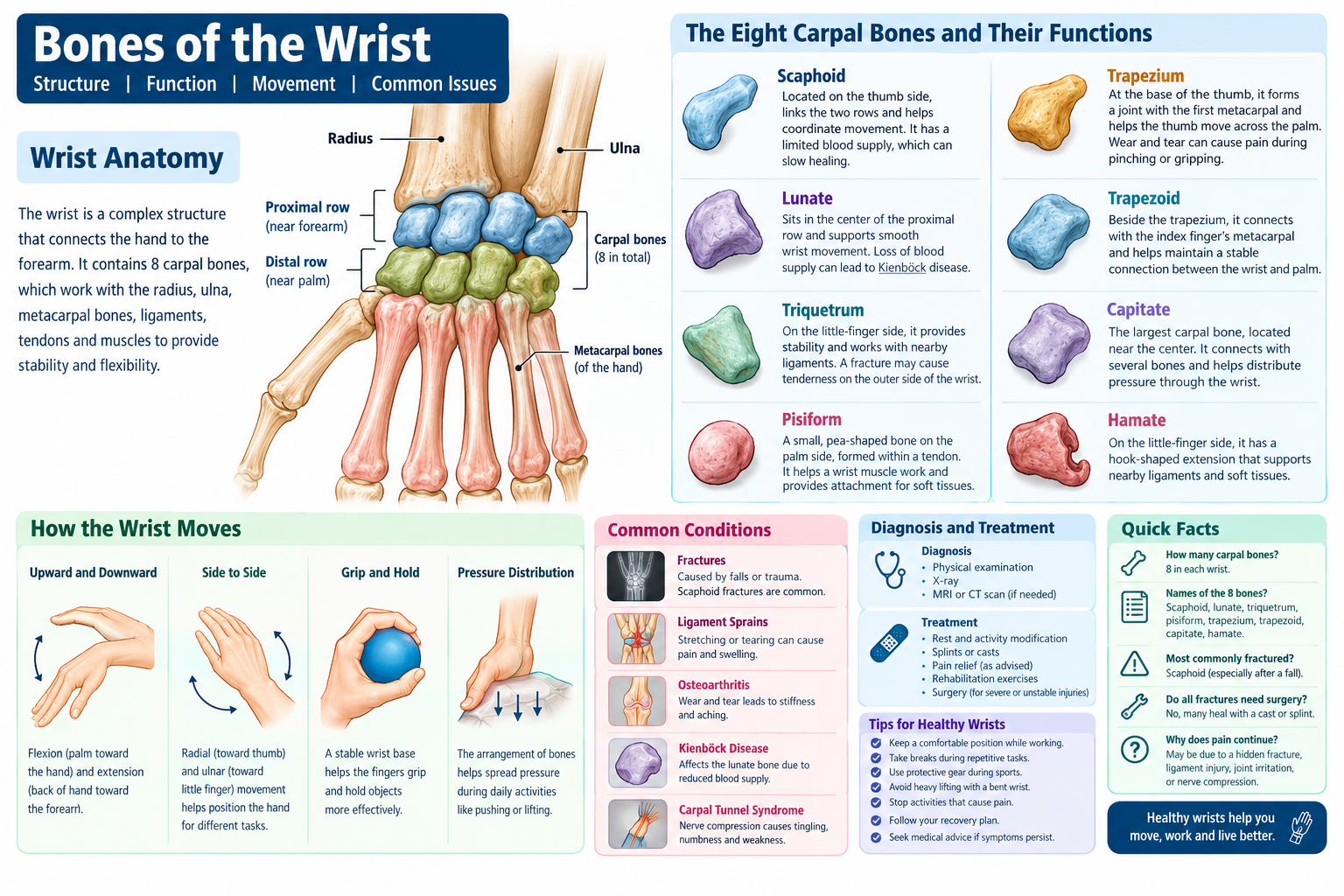
The wrist is a small but complex part of the body that helps the hand perform a wide range of movements. From holding a spoon to operating a computer mouse, many everyday tasks depend on the wrist working comfortably and correctly. Its structure includes eight small carpal bones, supporting ligaments, tendons, and joints that work together to control hand movement.
Learning about the bones of the wrist provides a better understanding of how the hand gains flexibility, where certain injuries occur, and why wrist pain sometimes makes ordinary activities difficult.
Table of Contents
Understanding Wrist Anatomy
The wrist region contains several connected structures rather than one single bone or joint. Eight carpal bones form its central framework, while the radius, a forearm bone, meets the carpal bones to create the main wrist joint.
The ulna lies on the opposite side of the forearm. Although it is close to the wrist, a cartilage structure helps connect and stabilize this side of the joint. Beyond the carpal bones, five metacarpal bones form the framework of the palm.
These structures have different responsibilities. Bones provide support, ligaments hold joints together, and tendons transmit the force produced by muscles. Their coordinated action allows the hand to move while maintaining enough stability to hold objects.
The Eight Carpal Bones and Their Individual Roles
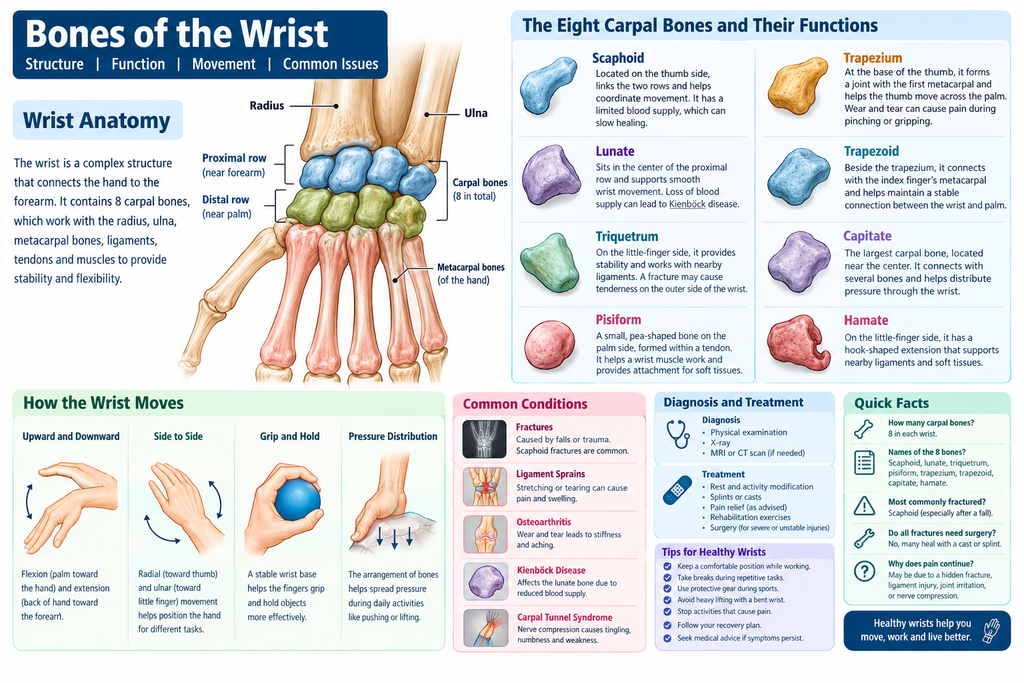
Each wrist contains eight carpal bones. Their shapes and positions help them perform different tasks within the same compact structure.
Scaphoid: A Link Between Two Rows
The scaphoid sits near the base of the thumb and has a curved shape. It connects the proximal and distal rows of carpal bones and contributes to their coordinated movement.
Its blood supply is an important feature of its anatomy. Some scaphoid fractures receive less blood flow than others, which can make healing more difficult. After a fall, tenderness near the thumb side of the wrist deserves attention even when swelling is not obvious.
Lunate: Supporting Coordinated Movement
The lunate occupies a central position in the row nearest the forearm. Its shape allows it to move in coordination with neighboring bones as the wrist changes direction.
The lunate also contributes to joint alignment. A condition called Kienböck disease can damage this bone when its blood supply is impaired. Persistent central wrist pain and stiffness may require a medical examination.
Triquetrum: Stability on the Little-Finger Side
The triquetrum is located toward the little finger and has a roughly triangular shape. It works with nearby bones and ligaments to support the wrist during movement.
An injury to this bone may cause tenderness on the little-finger side of the wrist. Pain can become more noticeable when placing weight on the hand or moving the joint.
Pisiform: A Small Bone Within a Tendon
The pisiform is a pea-shaped bone found on the palm side of the wrist. It differs from most other carpal bones because it develops within a tendon.
Its position improves the action of a wrist muscle and provides attachment points for soft tissues. Direct pressure on the palm near the little finger may irritate this area or cause pain if the bone is injured.
Trapezium: Helping the Thumb Work Independently
The trapezium lies at the base of the thumb. Its joint with the first metacarpal allows the thumb to move across the palm and oppose the fingers.
This movement is essential for picking up small items, fastening clothing, and gripping tools. Wear and tear in this joint can cause discomfort during pinching or twisting activities.
Trapezoid: Supporting the Index Finger
The trapezoid is a small bone positioned beside the trapezium. It connects with the base of the index finger’s metacarpal bone and helps maintain a stable connection between the wrist and palm.
Although fractures of this bone are uncommon, a significant impact may injure it. Because its symptoms can resemble other wrist problems, an examination may be necessary to identify the cause.
Capitate: The Central Supporting Bone
The capitate is the largest carpal bone and sits near the middle of the wrist. Several neighboring bones connect with it, giving it an important role in the structure of the joint.
It helps transfer pressure through the wrist when the hand pushes, lifts, or supports an object. A fracture may cause pain and swelling, particularly following a significant injury.
Hamate: Protection and Support Near the Palm
The hamate is found on the little-finger side of the row closest to the palm.The hamate bone has a small, hook-shaped extension that helps support nearby ligaments and soft tissues in the wrist.
This projection serves as an attachment point for soft tissues and forms part of the boundary of nearby anatomical passages. Repeated pressure from sports equipment, such as a bat or golf club, may contribute to injury in this region.
Why Are the Wrist Bones Organized Into Two Rows?
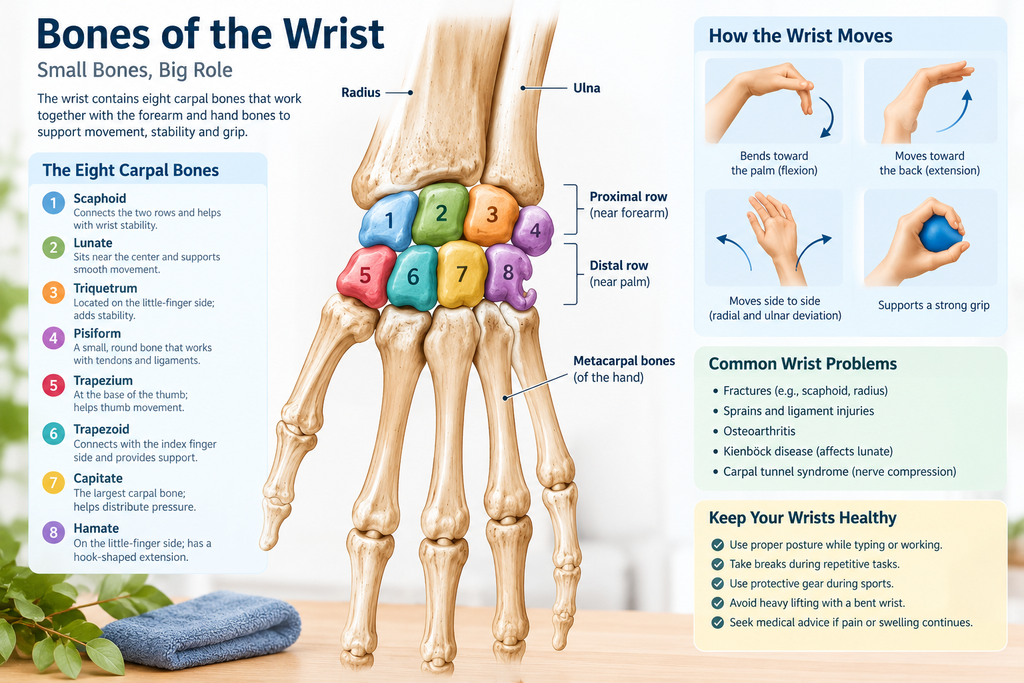
The eight carpal bones are grouped according to their position, with four bones in each row. This arrangement helps the wrist combine controlled movement with a stable connection to the hand.
The row nearest the forearm consists of the scaphoid, lunate, triquetrum, and pisiform. These bones participate in the movement of the wrist and interact with the surrounding joint structures.
The row nearest the palm contains the trapezium, trapezoid, capitate, and hamate. These bones connect with the metacarpals and help form the supporting base of the hand.
The two rows function as a coordinated system. Small movements between the bones allow the wrist to adjust to different positions, while ligaments limit excessive movement that could damage the joint.
How the Wrist Produces Different Movements
Wrist movement results from several joints working together. The carpal bones change position in a coordinated way, allowing the hand to move in different directions.
How the Wrist Moves Upward and Downward
Flexion brings the palm closer to the forearm, while extension moves the back of the hand toward the forearm. These movements are useful when writing, reaching for objects, and changing the position of the hand during work.
Moving Toward the Thumb or Little Finger
The wrist can also move from side to side. This helps position the hand for tasks such as using a screwdriver, pouring from a container, or reaching across a surface.
Maintaining Control During Gripping
A firm grip requires the wrist to provide a dependable base for the muscles that control the fingers. If the wrist is painful or unstable, lifting and holding objects may become more difficult.
Managing Pressure During Daily Activities
When a person pushes against a surface or carries a heavy bag, force passes through the hand and wrist. The arrangement of the bones helps distribute that pressure, but excessive force or an awkward landing can still cause injury.
Conditions That Can Affect the Wrist Bones
Wrist problems may begin after an accident or develop gradually. The symptoms depend on whether the injury affects a bone, ligament, joint, tendon, or nerve.
Fractures
A fracture is a break in a bone caused by force, trauma, or sometimes weakened bone tissue. Falls and sports injuries are common causes of wrist fractures.
A broken wrist may produce tenderness, swelling, bruising, and difficulty moving the hand. Some fractures are difficult to detect on an initial X-ray, so continuing pain after an injury should not be ignored.
Ligament Injuries
Ligaments connect bones and help control movement between joints. If a ligament stretches beyond its normal limit or tears, the wrist may become painful and swollen.
A sprain and a fracture can produce similar symptoms. Medical assessment helps determine whether the injury requires protection, imaging, or further treatment.
Joint Wear and Tear
Changes in joint cartilage can contribute to osteoarthritis. When the wrist or thumb-base joint is affected, a person may experience stiffness, aching, and difficulty with repetitive gripping.
Previous fractures or injuries that affect joint alignment may increase the risk of later joint problems.
Reduced Blood Supply to a Bone
Some wrist conditions affect the circulation that keeps bone tissue healthy. Kienböck disease, for example, affects the lunate bone.
Symptoms may include persistent pain, stiffness, and reduced wrist function. Early assessment can help identify the problem and determine suitable care.
Nerve Compression
Not every wrist problem originates in a bone. Carpal tunnel syndrome develops when the median nerve is compressed as it passes through a narrow passage in the wrist.
This can cause tingling, numbness, pain, or weakness in parts of the hand. Recognizing the difference between nerve symptoms and bone pain helps guide appropriate medical assessment.
How Doctors Identify Wrist Injuries
A medical evaluation usually starts with questions about when the pain began, how the injury occurred, and which movements make symptoms worse. The clinician may examine swelling, tenderness, finger movement, sensation, and blood circulation.
An X-ray is commonly used to check for fractures and changes in bone alignment. If the images do not explain the symptoms, additional testing may be considered.
MRI can help identify certain hidden fractures and soft-tissue injuries. CT scans provide detailed views of bone structure and may be useful when a fracture is complex.
The choice of examination depends on the suspected injury and the patient’s symptoms.
Approaches to Wrist Injury Treatment
The best treatment depends on the affected structure, the seriousness of the injury, and whether the wrist remains stable.
Activity modification: Temporarily avoiding painful movements can reduce further irritation. Severe pain after an accident should be assessed rather than treated through rest alone.
Splints and casts: Certain fractures need immobilization to keep the injured area stable while healing takes place. The type and duration of support depend on the specific injury.
Pain management: A clinician or pharmacist can advise on suitable pain relief after considering other health conditions and medications.
Rehabilitation: Once the injury is stable, recommended exercises may help restore movement and strength. Starting exercises too early can interfere with the healing of some fractures.
Surgery: Some unstable or displaced fractures require an operation to restore alignment. Surgery may also be considered for selected joint or ligament problems.
To explore how wrist bones work together and learn about common wrist conditions, read this helpful guide from MedlinePlus on wrist injuries and disorders
Everyday Habits That Support Wrist Health
Protecting the wrist involves reducing unnecessary strain and responding appropriately when symptoms develop.
- Adjust your keyboard and mouse position so your wrists remain comfortable.
- Take regular breaks during tasks involving repeated hand movements.
- Use suitable protective equipment for sports and physical activities.
- Avoid lifting heavy objects with a sharply bent wrist.
- Stop activities that cause sharp or worsening pain.
- Follow the recommended recovery plan after an injury.
- Seek professional advice if discomfort, swelling, or reduced movement persists.
These measures can support healthy wrist function, although they cannot prevent every fracture or joint condition.
Frequently Asked Questions
How many carpal bones are in the wrist?
There are eight carpal bones in each wrist. Together, they help connect the forearm to the hand and support coordinated movement.
What are the names of the eight wrist bones?
The bones are the scaphoid, lunate, triquetrum, pisiform, trapezium, trapezoid, capitate, and hamate.
Which wrist bone is commonly injured in a fall?
The scaphoid is a common carpal bone fracture after a fall onto an outstretched hand. The radius, which belongs to the forearm, is also frequently fractured near the wrist.
Can a wrist fracture be present without major swelling?
Yes. Some fractures cause relatively mild swelling, especially at first. Persistent pain or tenderness following an accident should be assessed even when the wrist looks normal.
Do all wrist fractures need surgery?
No. Many stable fractures can be treated with a cast or splint. Surgery may be necessary when a fracture is displaced, unstable, or likely to heal in an incorrect position.
Why does wrist pain sometimes continue after an injury?
Pain may persist because of an unrecognized fracture, ligament damage, joint irritation, or another condition. A healthcare professional can decide whether further examination or imaging is needed.
Conclusion
The wrist is a carefully coordinated structure in which eight carpal bones work with the forearm, palm, ligaments, and tendons. Their arrangement allows the hand to change position, hold objects, and perform detailed movements while maintaining stability.
Understanding the bones of the wrist can help readers recognize common injuries and appreciate why persistent symptoms deserve attention. If an injury causes severe pain, visible deformity, numbness, or continuing difficulty using the hand, seek appropriate medical care.
Medical disclaimer: This article is for general educational purposes and should not be used as a substitute for professional medical advice, diagnosis, or treatment.
